
What Drivers in Orleans Parish Need to Know

March 26, 2026

Picking a Window Tint Shop in New Orleans, LA: What Drivers in Orleans Parish Need to Know

New Orleans presents one of the most demanding climates for window film in the United States. Orleans Parish sits at sea level along the Mississippi River corridor, surrounded by Lake Pontchartrain to the north and subject to sustained Gulf Coast heat, extreme humidity, salt air, and UV exposure that operates year-round. 


Vehicles navigating I-10, the Crescent City Connection, and the Claiborne Avenue corridor accumulate interior heat rapidly, and the city’s persistent moisture creates adhesive and topcoat stress that inferior film simply cannot withstand across multiple seasons. 


Evaluating what determines installation quality in this environment prevents early failure and avoidable repeat expense.


Why Film Construction Matters More in New Orleans

No factor in a window tint installation affects long-term performance more than the film itself, and in New Orleans, the margin between quality and inferior construction is more consequential than in less demanding climates.


In a general sense, dyed films may experience color instability and declining infrared heat rejection under Orleans Parish’s combination of sustained UV, coastal salt air, and extreme humidity, depending on the manufacturer and construction quality.


A more reliable option uses non-dye-based technology specifically engineered for high-heat, high-humidity coastal environments, such as those made by HITEK Films, which apply nano-ceramic and carbon-ceramic construction designed to maintain thermal performance, color stability, and adhesive integrity through the conditions New Orleans vehicles face year-round.


Humidity, Salt Air, and Installation Standards

New Orleans’ combination of coastal salt air and persistent humidity creates installation conditions that demand a higher level of preparation than most other markets. Film applied over glass that retains salt residue, moisture, or organic contamination from the city’s environment bonds inconsistently and develops adhesion failures within the first year of use.


What uncontrolled installation conditions produce for New Orleans drivers:

  • Salt residue and moisture trapped beneath the adhesive create bonding inconsistencies that develop into edge lifting in Orleans Parish’s persistently humid environment.
  • Airborne organic contamination from the city’s dense tree canopy and waterway proximity becomes permanently embedded in film applied without a clean, enclosed installation bay.
  • Adhesive delamination along door seams and window edges develops faster when surface decontamination is inadequate before film application in high-humidity coastal conditions.


An enclosed, controlled installation environment with thorough chemical decontamination before any film is applied is the appropriate standard for achieving durable results in New Orleans.


Curing Timeline in a High-Humidity Climate

Film adhesive cures through moisture evaporation between the film and glass surface after installation. In New Orleans’ consistently high ambient humidity, this process extends longer than in drier or inland markets, and disrupting the film before the adhesive has fully stabilized produces edge lifting and adhesion failure that shortens the installation’s effective life.


Keeping windows closed for several days after installation is the correct baseline in any season in Orleans Parish. During peak summer humidity, this curing window may extend further, and a shop familiar with Gulf Coast installation conditions will communicate the appropriate timeline based on the season in which work is performed.


What Manufacturer Warranty Coverage Actually Includes

A warranty on window film is a documented commitment to specific performance standards after installation is complete. For New Orleans drivers, reviewing what a warranty covers before booking is more practical than reviewing it after a defect appears months later.


Quality manufacturer warranties cover film defects including peeling, bubbling, cracking, and fading beyond defined thresholds during the warranty period. Physical damage from sharp objects, abrasive cleaning tools, and customer misuse falls outside defect coverage. Installation workmanship issues are addressed separately from product manufacturing defects.


Key warranty factors for Orleans Parish drivers to confirm:

  • Manufacturer documentation for the specific film product being installed should be available, not just a general shop policy.
  • Authorized dealer requirements for brands such as HITEK Films mean warranty coverage applies to qualifying products installed following manufacturer procedures.
  • Post-installation care compliance affects warranty validity, and following the shop’s curing and maintenance instructions from day one preserves coverage throughout the full warranty period.


Frequently Asked Questions

What is the legal front window VLT in Louisiana?

Louisiana requires at least 25% visible light transmission on front side windows for passenger vehicles. Rear side and back glass allow darker applications by vehicle type. Windshield tint is limited to a non-reflective strip above the AS-1 line under Louisiana RS 32:361.1, applying across Orleans Parish.


Does ceramic film interfere with toll systems or navigation?

Non-metallic ceramic films do not affect GPS navigation, cellular signals, or electronic toll systems. This is relevant for New Orleans drivers using the Lake Pontchartrain Causeway toll system and navigating I-10 and I-610 regularly.


How long should windows stay closed after installation in New Orleans?

In Orleans Parish’s high humidity, film adhesive requires more time to fully stabilize than in drier climates. At minimum, several days of closed windows is appropriate, with longer curing expected during the most humid months of the year.


Is old tint removal required before installing new film?

Yes. Applying new film over existing tint creates adhesion inconsistencies, affects the combined VLT reading under Louisiana’s 25% front window standard, and produces visual distortion. Professional removal of old film before a new installation proceeds correctly.

📲 Text or call for a professional quote on window film suited to New Orleans conditions. From daily drivers in Orleans Parish to residential properties near the lakefront, getting the right film specification and installation standard the first time is the most cost-effective decision you can make in this climate.​​​​​​​​​​​​​​​​


By Shubham Singh March 26, 2026
Aftermarket vs Factory Window Tint in New Orleans, LA: What Drivers Should Know If you’re driving in New Orleans, you already know how relentless the sun can be. Whether you’re sitting in traffic on I-10 or parked in the French Quarter, heat and glare are a daily reality. That’s why so many drivers here start asking the same question: is the tint that came with your vehicle good enough, or is aftermarket window tint worth the upgrade? Understanding the difference between factory and aftermarket tint helps you make a more informed decision about your vehicle and your comfort. What Is Factory Window Tint? Factory tint, also called privacy glass or OEM tint, is built directly into the rear side and back windows of a vehicle during manufacturing. It’s a dye fused into the glass itself, not a film applied to the surface. This type of tint does reduce visible light and adds a degree of privacy. However, in a general sense, dyed-glass tinting tends to offer limited heat rejection and minimal UV protection compared to aftermarket film options. The darker appearance can be misleading because the glass blocks light without necessarily blocking the infrared heat that makes your car feel like an oven after sitting in a New Orleans parking lot. Factory tint also typically offers no coverage on the front side windows or windshield, leaving the driver and front passenger fully exposed to direct sun. What Is Aftermarket Window Tint? Aftermarket tint is a polyester-based film professionally applied to the interior surface of your vehicle’s glass. It comes in a wide range of materials, each engineered to perform differently depending on your priorities. Common Aftermarket Film Types Dyed film is the most basic option and is typically the most affordable. In a general sense, lower-grade dyed films can fade or lose effectiveness over time depending on the manufacturer. For longer-lasting results, higher-quality dyed or hybrid options, such as those made by HITEK Films, use more advanced formulations designed for durability in high-heat climates like Louisiana. Carbon film eliminates the metallic content found in older films, making it signal-friendly for GPS, Bluetooth, and mobile devices. It delivers solid heat rejection and a clean, matte finish that holds up well over time. Ceramic film sits at the top of the performance tier. Ceramic technology, such as the options available through HITEK Films, blocks a significant portion of infrared heat without affecting visibility or electronic signals. It’s particularly well-suited to the intense, sustained heat that New Orleans summers bring. Factory Tint vs. Aftermarket Tint: Key Differences Factory glass tinting and aftermarket film serve different purposes. Factory tint is primarily cosmetic and provides basic privacy. Aftermarket film is engineered to manage heat, glare, and sun exposure with far greater precision. The biggest practical difference comes down to heat performance. A vehicle with only factory tint will still absorb substantial radiant heat through the glass. Aftermarket film, especially ceramic options, creates a meaningful barrier between the sun and your car’s interior. Aftermarket film also gives you control over which windows are treated and at what level. You can address the front windows and windshield that factory tint leaves completely unprotected, which matters significantly in a city where afternoon sun hits drivers head-on. Why New Orleans Climate Makes This Decision Matter New Orleans sits in a subtropical climate zone. Long summers, intense UV exposure, high humidity, and frequent direct sunlight mean that vehicles here endure more solar stress than in most other parts of the country. Interior surfaces, dashboard materials, and seating fabrics are especially vulnerable to prolonged sun exposure without proper window protection. Aftermarket window film, particularly high-performance ceramic options from a brand like HITEK Films, is designed to hold up in exactly these conditions. For New Orleans drivers, it isn’t just an aesthetic upgrade. It’s a practical one. Frequently Asked Questions Is factory tint enough for New Orleans heat? Factory tint reduces visible light but typically provides limited heat rejection. In a climate like New Orleans, most drivers find aftermarket film offers noticeably better protection from solar heat and glare. Can aftermarket tint be applied over factory glass? Yes. Aftermarket film is applied to the interior glass surface and works alongside factory-tinted glass without any conflict. Will window tint interfere with my car’s electronics? Carbon and ceramic films are non-metallic and do not interfere with GPS, Bluetooth, satellite radio, or cellular signals. Is window tinting legal in Louisiana? Louisiana has specific laws regulating tint darkness and reflectivity by window position. A licensed installer will apply tint that meets state-legal VLT requirements.
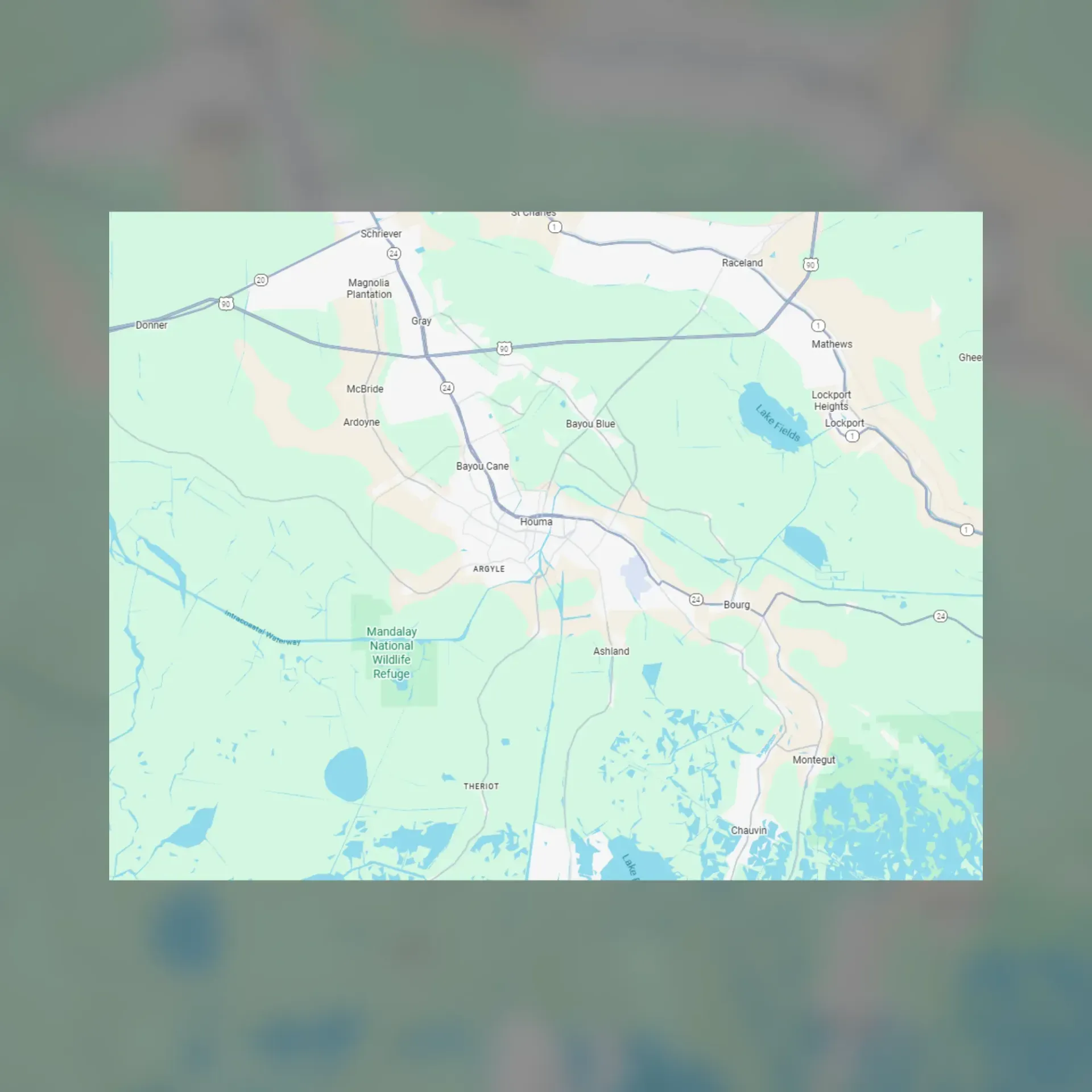
Map of Houma, Louisiana, and the surrounding area.
By arturo chapa December 17, 2025
Louisiana Tint Laws (2026): What’s Legal for Car Window Tinting?